
The best time to race on iRacing
The quality of your race is decided before the green flag, by which slot you entered. Most drivers pick the one that fits their evening and accept whatever turns up. Picking on data instead is one of the few free improvements available in sim racing.
Why the timeslot decides the race
iRacing sorts an entry list into splits by iRating. That single mechanic is the reason participation matters so much: more entrants means more splits, and more splits means the drivers around you are genuinely close to your level. A deep slot might produce six splits with a few hundred points of spread each. A thin one produces a single split containing everyone from rookies to aliens, and a race that is effectively decided at turn one.
The same effect governs how much your result is worth. A close split gives you a realistic expected finish, so beating it means something. Being dropped into a split you were never going to win — or never going to lose — produces an iRating change that tells you very little about how you drove.
Reading the participation heatmap
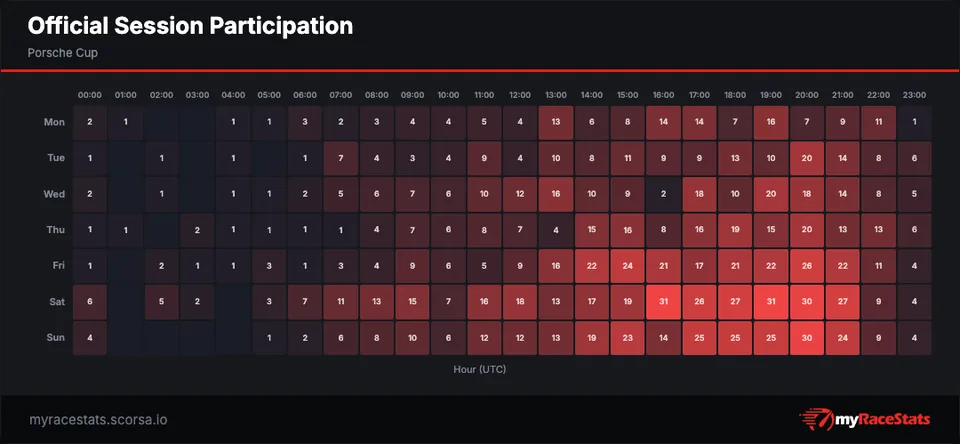
/participation plots sessions by day of week and hour of day, in UTC, with darker cells
for more drivers. What you are looking for is not the single darkest cell — it is the block of consistently
dark cells that overlaps with the hours you can actually race. A slot that is excellent once a week
is worth less than one that is good four nights out of seven.
Two companion views sharpen it. /officials shows how many official sessions actually
ran in each slot rather than how many drivers were online, which catches the case where a
popular hour still fails to fill a particular series. /strengthoffield maps top-split
Strength of Field by week, so you can see which weeks of a season drew the strongest fields.
Strong field or safe field
Strength of Field scales the points on the table. A high-SoF split has more to gain and more to lose, and there is no universally correct answer about which to enter — but there is a correct answer for a given week:
- Learning the combo — take the quieter slot. Bank laps, keep the car clean, protect your Safety Rating, and treat the result as irrelevant.
- Confident on the combo — take the deep slot. Your expected finish is computed against genuinely comparable drivers, so a good result pays properly.
- Chasing a licence or a clean streak — depth still helps. Closer racing produces less first-corner chaos than a single split with a 3000-point spread.
Picking a series that will actually fill
A series that looks appealing on the schedule is worthless if it runs four cars. /popularity ranks every active series by unique driver count, which is the honest measure
of whether it will fill in your region. /schedule then gives the week-by-week track list
for a season, so you can plan around the tracks you know rather than discovering the combo on race
night.
Combining the two is the actual workflow: find the series with the drivers, check the weeks with tracks you like, then use the heatmap to pick the hour. It takes about two minutes and it changes the next three months of racing.
Common questions
When is the best time to race on iRacing?
It depends entirely on the series and your timezone, which is why a general answer is useless and a heatmap is not. /participation plots sessions by day and hour in UTC with darker cells for more drivers, so you can read the busy slots for the series you actually race rather than the ones a forum post recommends.
Why does a busier timeslot give me a better race?
More drivers means more splits, and splits are sorted by iRating. In a deep timeslot you are matched against people genuinely close to your rating, which produces a closer race and a more meaningful result. A thin slot compresses the whole entry list into one split with an enormous rating spread, and the race is usually decided in the first corner.
What is Strength of Field and should I chase it?
Strength of Field is the average rating of the drivers in your split, and it scales how much iRating is on the table. A strong field means more to gain and more to lose. Chase it when you want the points and the practice; avoid it when you are learning a combo and would rather bank a clean finish.
How do I tell which series are actually active this season?
/popularity ranks every active series by unique driver count, which is the honest measure of whether a series will fill. /officials shows how many official sessions actually ran in each slot, as opposed to how many drivers were around.
Are the heatmap times in my local timezone?
No — the participation heatmap is in UTC, so convert once for your own timezone and the pattern holds week to week.