
iRacing Safety Rating, and where your incidents actually come from
Most drivers watch the number and guess at the cause. The number is a summary of two things you can measure directly: how far you race, and what kind of incidents you pick up along the way. The second one is where the improvement is.
The rating is a rate, not a tally
Safety Rating is built on corners completed per incident. That framing matters more than it first appears, because it means distance is the denominator. A clean four-lap sprint barely moves the rating; a clean hour moves it a lot. This is why drivers grinding short races wonder why their licence never progresses while someone doing one endurance stint a week climbs steadily — same cleanliness, very different corner counts.
It also means a single bad race does less damage than it feels like, provided you keep racing distance afterwards. The instinct to stop driving after a rough week is exactly backwards.
Not all incidents cost the same
iRacing weights incidents rather than counting them. Running wide onto the grass is the cheapest thing you can do; losing the car is worse; hitting someone is the expensive one — contact scores around four times what a single off-track does. Two collisions therefore outweigh eight track-limits excursions, even though the second driver's incident count looks four times worse on the result screen.
This is the single most useful thing to know about your own driving, because the two problems have completely different fixes. Off-tracks are a track-limits and discipline problem, and they respond to a session of deliberate practice. Contact is an awareness and racecraft problem, and it responds to closing rate, mirrors and patience. Working on the wrong one is why plateaus happen.
Seeing the breakdown for a real race
The incidents card splits a race out per driver into contact, off-track and spin counts, rather than reporting one aggregate. Read your own row and the pattern is usually obvious within seconds — a column of off-tracks is a very different week from a column of contact.

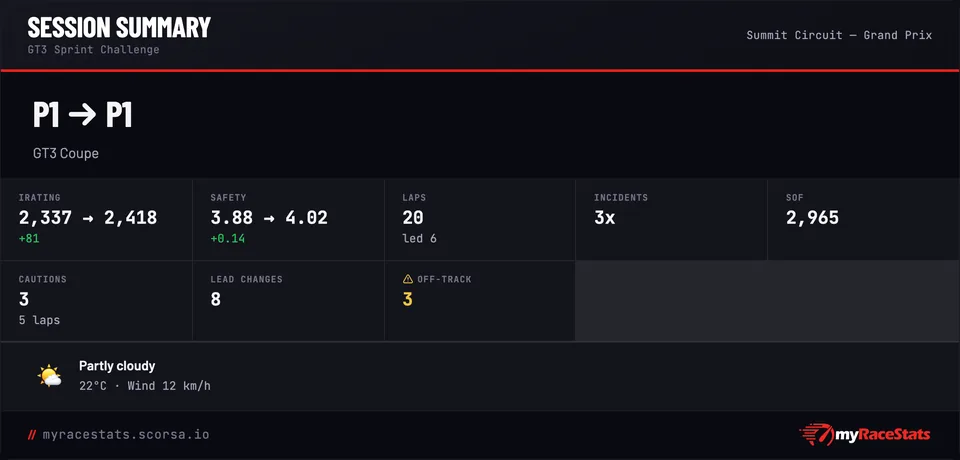
The session summary that lands after a race adds the context around the number — field size, Strength of Field, weather and cautions alongside your own incident breakdown. A three-incident race in a wet, caution-heavy session is a good result; the same three in a dry, green-flag sprint is not, and the summary is what lets you tell those apart.
Finding the lap it happened on
Counts tell you what; the lap chart tells you when. The animated lap graph marks incidents lap by lap and shades caution periods, so a cluster on lap one is immediately distinguishable from a cluster at the end of a stint. First-lap contact and tyres-gone contact are different mistakes with different fixes.
Tracking it across a team
For a roster, the weekly Safety Rating card is the right altitude — one card, every driver, the
week's movement. /team quick_stats gives a broader snapshot that includes a safety
rating breakdown alongside recent results and average iRating, and /manage_team roster lists each driver's licence grade next to their iRating.

Safety Rating and iRating move independently and are worth reading together. A driver gaining iRating while losing SR is buying results with risk, and that trade tends to correct itself the week a licence drops.
Common questions
Why is my Safety Rating falling when my incident count looks fine?
Because incidents are weighted, not counted. Contact with another car scores four times what a single off-track does, so two collisions cost more than eight track-limits excursions. A driver comparing raw incident totals with a team-mate is comparing the wrong number — the mix is what moves the rating.
What counts as an incident in iRacing?
Running all four wheels off the racing surface, losing control, and making contact with another car or an object. myRaceStats breaks a race down into contact, off-track, spin, tow and black-flag events per driver, so you can see which of those you are actually accumulating rather than just the total.
Does Safety Rating go up in every clean race?
Not automatically. Safety Rating is driven by how many corners you complete per incident, so a clean four-lap sprint moves it far less than a clean hour of racing. Distance is what builds it — which is why a tidy endurance stint is worth more to your licence than a flawless short race.
Do I have one Safety Rating or several?
One per licence category, each tracked independently. A clean sports car record does nothing for a dirt oval licence. /manage_team roster lists the licence grade alongside iRating for every driver on a team.
How do I see Safety Rating changes for my whole team?
The bot renders a weekly Safety Rating card for a roster, and /team quick_stats gives a team snapshot that includes a safety rating breakdown alongside recent results and average iRating.